
Filling Gaps Through Collaboration
How do we fill gaps in understanding and teach the required grade-level content?

How can I effectively teach Algebra 1 to students who struggle with adding integers?
Filling learning gaps is a familiar challenge for math teachers: regardless of grade level, gaps in prerequisite knowledge are a significant hurdle.
How do we move on to new content when students lack prerequisite knowledge?
How do we fill these gaps in understanding so we can teach the required grade-level content?
Let’s explore the issue in the context of solving quadratic equations using the Zero Product Property. Factoring itself is generally a difficult concept for students to master, and adding another step makes it even more challenging.
Please take a minute to reflect on the prerequisite knowledge a student needs to solve this problem. How many items are on your list?
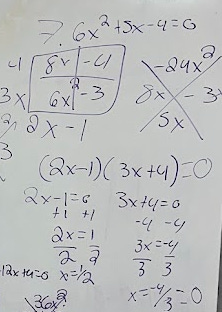
For instance, I found 12 prerequisites; your list may be even longer.
Understand the area model (area of a rectangle is side times side)
Exponents Rules: x times x is x squared, not 2x.
Adding like terms 8x+-3x=5x
Factors of -24
Multiplying integers 8( -3)= -24
Adding integers 8+-3=5
Factors of 6
Multiples of -3 and 2
Zero Product Property: anything times 0 is 0
Additive inverses
Multiplicative inverse
What an equation means compared to an expression
That’s quite a substantial number to consider!
Now, consider the new content knowledge required for this problem: there is actually none. Students have seen every concept; the new element is putting them together.
Now imagine each of the 25-plus students in one class has a learning gap, but you don’t know which concept each struggles with. Or some students have no gaps, while others have several.
How are you going to fill in all the gaps so students can learn to solve quadratic equations? The answer is you can’t!
So, back to the original question:
How do I teach this lesson when students don’t know who to ________________?
Over the years, I have tried many approaches to solve this issue, and one has proven effective.
What Doesn’t Work
Reviewing prerequisite concepts before teaching a new concept
Demonstrating with many examples while students take notes
Tracking
Individualized practice on a device
Review games
The issue with these methods is that they require me to fill in gaps for all of my students, which isn’t feasible. Even with technology that can identify gaps and assign tasks to each student based on need, I must still help each student. Students don’t magically understand a concept while working on a Chromebook.
What Does Work
Building a community of students who work together to help one another fill in gaps as they learn new content works best for me. You may be thinking, well, that sounds wonderful and impossible at the same time. While you are correct about the wonderful part, it is possible here’s how.
I’ve found that students can help each other fill learning gaps when I use the practices outlined in Building Thinking Classrooms. When students are working on thinking problems, they are exploring ideas and taking risks, and are much more likely to ask each other to explain an idea. When students work in random groups of three, they learn about one another and find common ground, which builds community and makes it a safe environment to ask questions and make mistakes. When students are working on a vertical, non-permanent surface, all their work is visible, allowing them to see one another’s work, discuss ideas, and identify common misconceptions. All of this helps students fill in each other’s knowledge gaps.
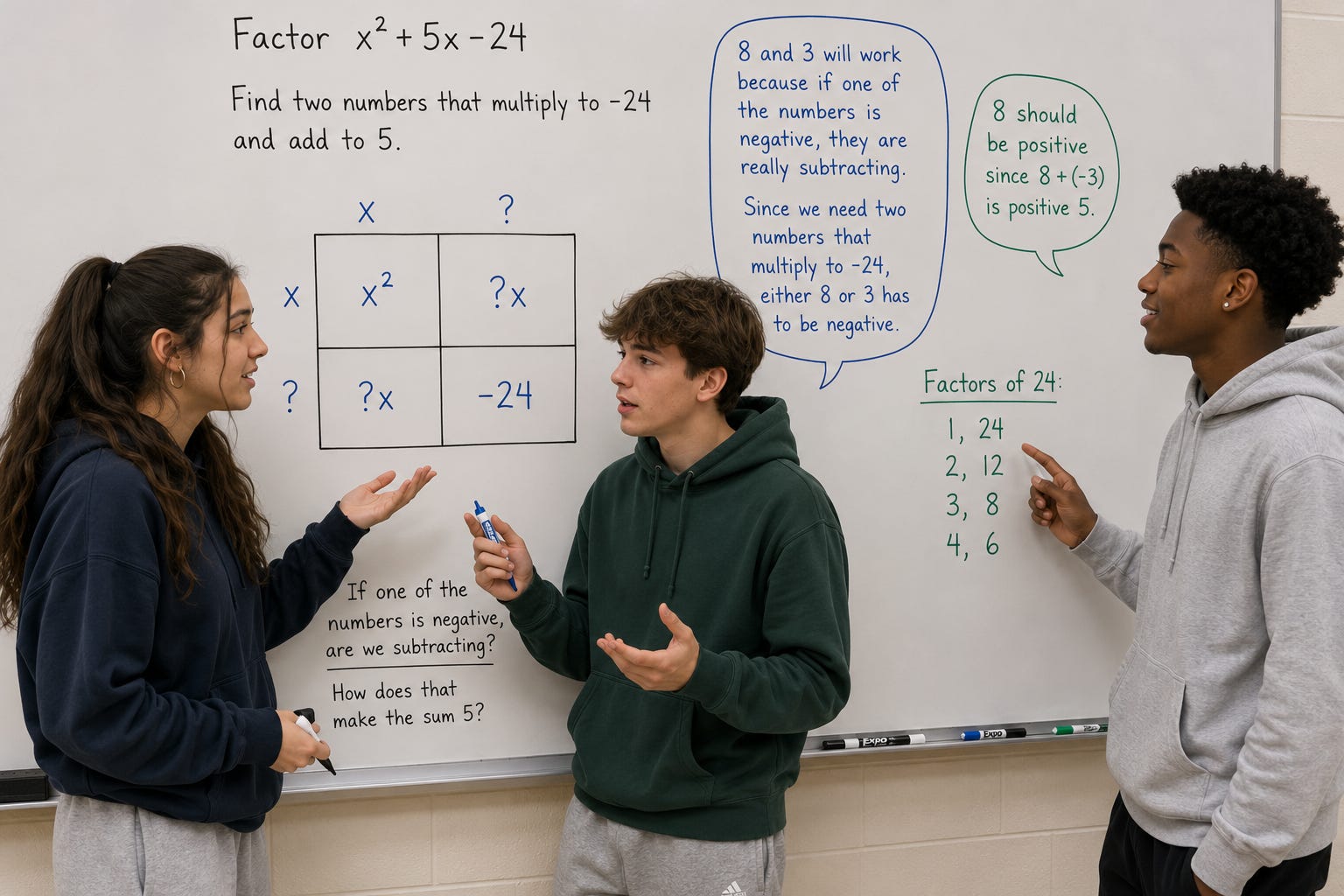
Imagine three students working together: Student A struggles with adding and multiplying integers, Student B with finding factors, and Student C with using the area model.
Student A starts drawing the area model and filling in information on the whiteboard. Student C is watching and asks questions about the area model. Student A explains to Student C that they need to find two factors of -24 that will add to 5. Student C jumps in and lists factors of 24, but Student A is confused because none of the factors add up to 5. Student B explains that 8 and 3 will work because if one of the numbers is negative, they are really subtracting, and since they are looking for two numbers that multiply to -24, either 8 or 3 has to be negative. Student C explains that 8 should be positive since 8 plus -3 is positive 5. Student A isn’t so sure about this and asks Student C more questions about adding the integers.
Now, let’s contrast this with what would happen if the same three students were working individually on the problem. Student C would not be able to start the problem because they couldn’t fill in the area model and would sit and wait for the teacher to help. Students A and B would be able to start the problem, but would then sit and wait for the teacher to help them individually find the factors of -24. Student B could then move on, but Student A would need more help understanding which number to make negative. In any case, these students might solve only one or two problems during the hour because gaps in their knowledge prevent them from moving on until the teacher intervenes.
Now, the impossible part: the teacher has 22 other students with gaps who also need help.
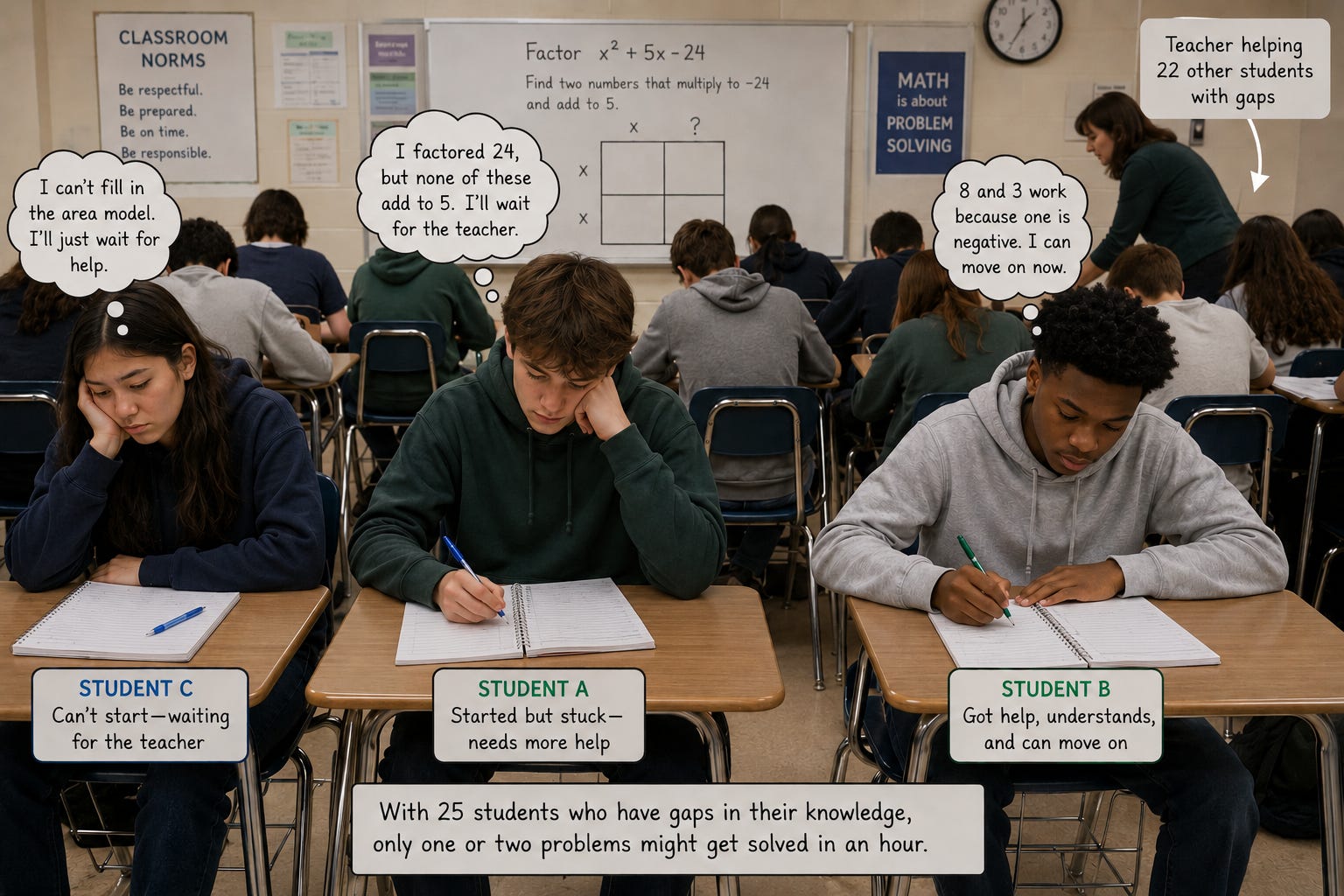
When each student worked individually, they couldn’t solve the problem without the teacher, and they weren’t thinking about the math; they were only thinking that they didn’t know what to do.
But when they worked together, collectively they had the knowledge needed to factor and solve a quadratic equation. The students were thinking and filling in gaps as they learned new content. Together, they solved more problems because they weren’t waiting for the teacher’s help. At the end of the lesson, Student A was more comfortable with the operations of integers, Student B began finding factors more confidently, and Student C knew how to use the area model.
Students were invested in understanding and addressing their learning gaps because they connected them to current class learning.
The biggest part of this narrative is that students felt success. Collectively, they felt confident in their answers and could also view other students’ work to compare with theirs. Success brings joy, and joy brings perseverance in problem-solving.
Community also plays a big part in this example. Students felt comfortable being vulnerable with each other. Just like thinking it takes time to build community. Students are not going to feel immediately secure enough with each other to admit a mistake or ask a question when they don’t understand something. Continually having students work in random groups of three helps build this community. While in these groups, the teacher must intentionally build status.
But There is More to the Story!
The other piece of this story is how do we measure success? The goal of this lesson was for students to factor and solve quadratic equations. And students are deemed successful by that marker. Meeting topic requirements is important, but the goal in my math class is to learn more math.
So let’s say that by the end of the lesson, Student A is not yet proficient at factoring and solving a quadratic equation, but knowing how to add and multiply integers has finally sunk in. Student A learned more math!
Shouldn’t we celebrate and reward students when they fill a gap, just as we do when they master a new concept?
You may be thinking, “ Well, one gap closed, but another opened.” However, with more practice, Student A should become proficient at solving quadratic equations, as there is no longer a learning barrier.
I mention this because, now that students are working at the whiteboards and their work is visible, I can see they are filling learning gaps. For example, this year I watched a boy who could not solve a two-step equation at the beginning of the year solve a linear systems problem using elimination while in his group.
By the end of the lesson, he wasn’t quite able to solve an entire elimination problem on his own, but he could confidently solve a two-step equation and substitute a value in for x to solve for y.
He learned more math!! It was a successful day.
Another time, I had a student follow me around the room with a mini whiteboard until I answered his question. He watched his partner factor out the Greatest Common Factor and didn’t understand, so he wanted me to explain. Since all work is visible on the whiteboards, my student identified a gap and went out of his way to fill it.
I was able to spend time addressing the GCF gap with him, since the other students were busy working together and didn’t need my help.
To sum up, fostering a classroom where students fill each other’s learning gaps transforms math learning. Start by Building a Thinking Classroom. As your students think together, you’ll be amazed at what they can accomplish!
I'm always excited to tie in examples in my personal life with the "learning community" philosophy. As an older adult, I can still struggle with technology and its tricks and tips, especially when it involves snafus and stumbles that I can't seem to unwind. I have friends who tell me to watch a YouTube video while others tell me to go to a computer store and have someone there troubleshoot the problem for me. I've done both with some success but my best learning happens when a few of us "mature" citizens get together and try to solve the problem together. It seems everyone can contribute something they know and that leads to an eventual solution. None of us are immediate experts, but we've all advanced our expertise in some way or another.